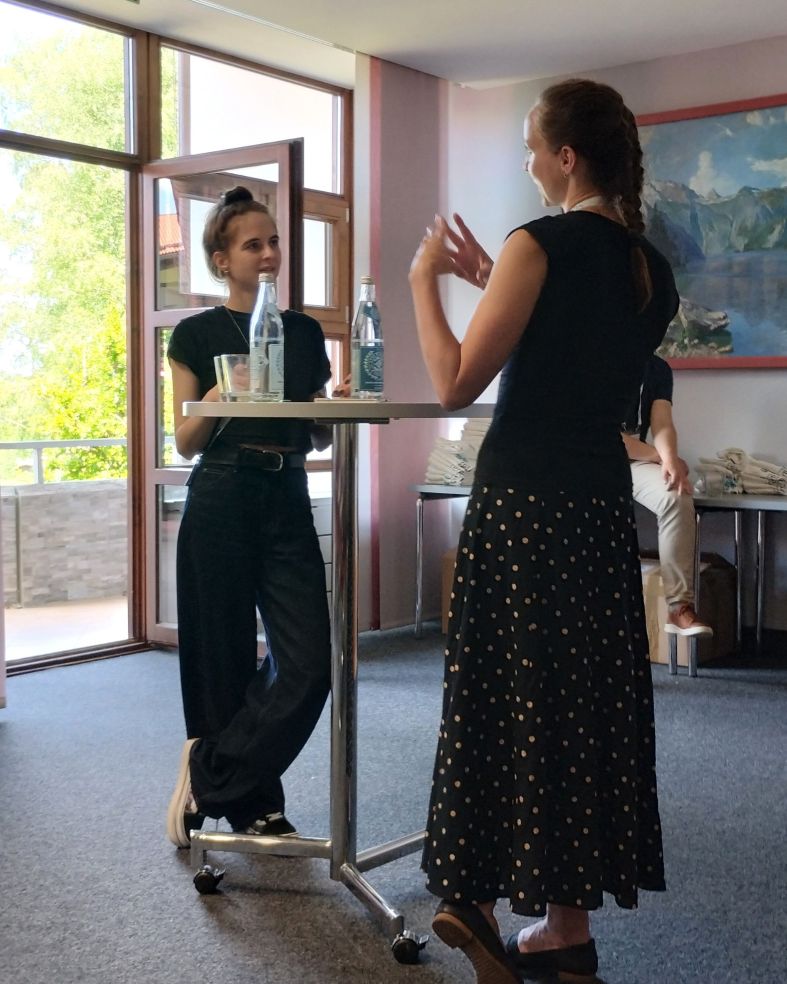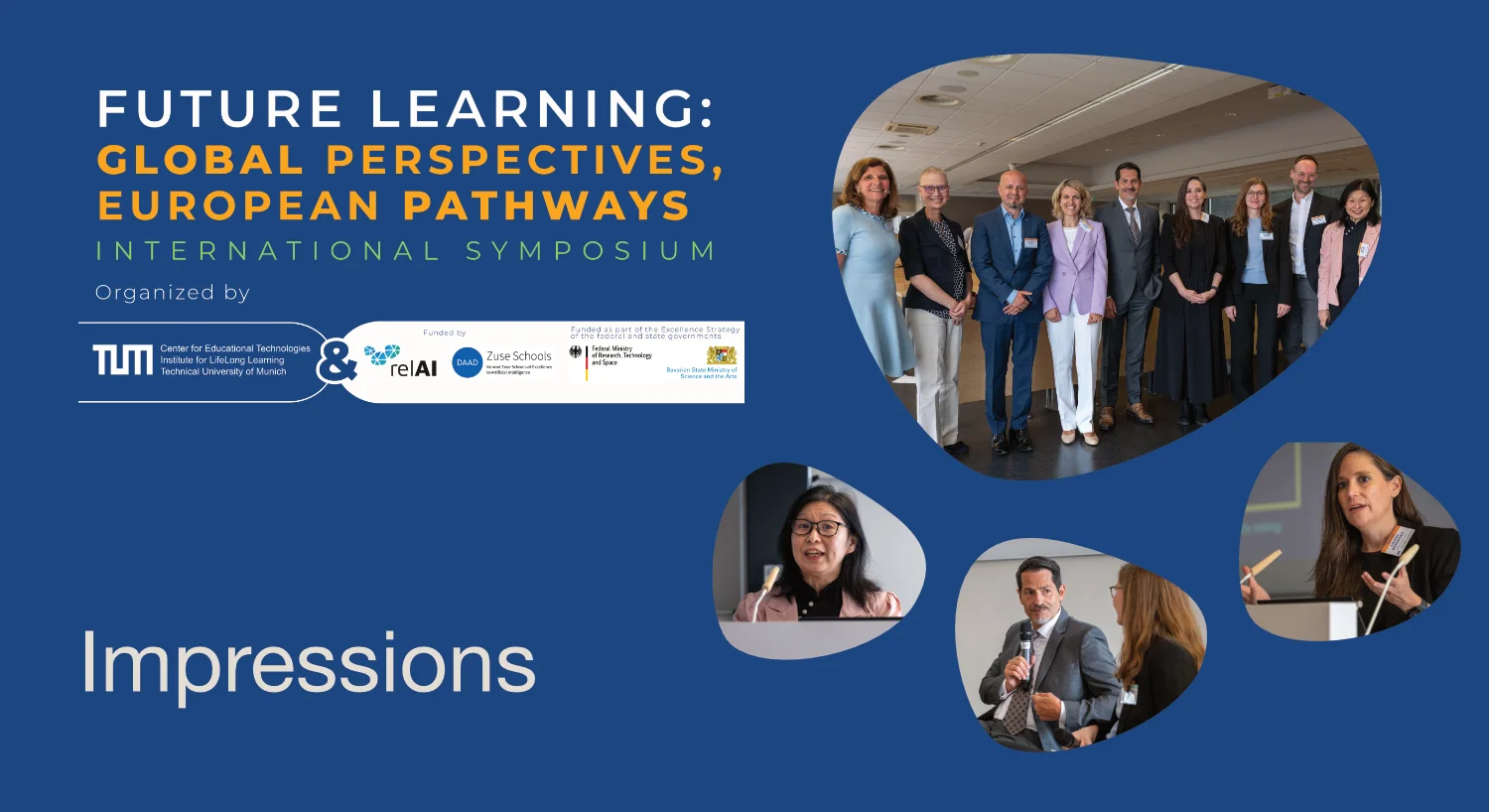
International Symposium on the Future of Learning

🔮How will artificial intelligence (AI) influence the future of learning?

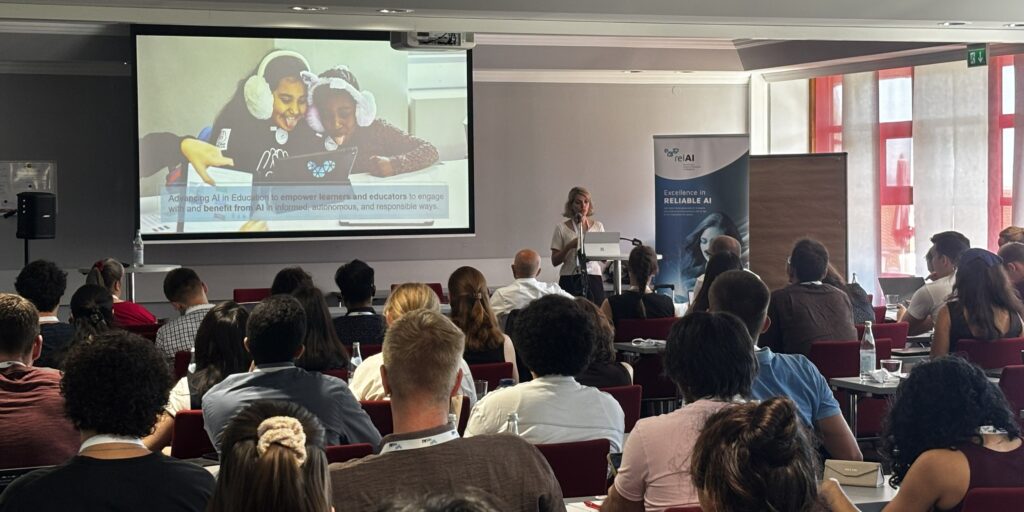
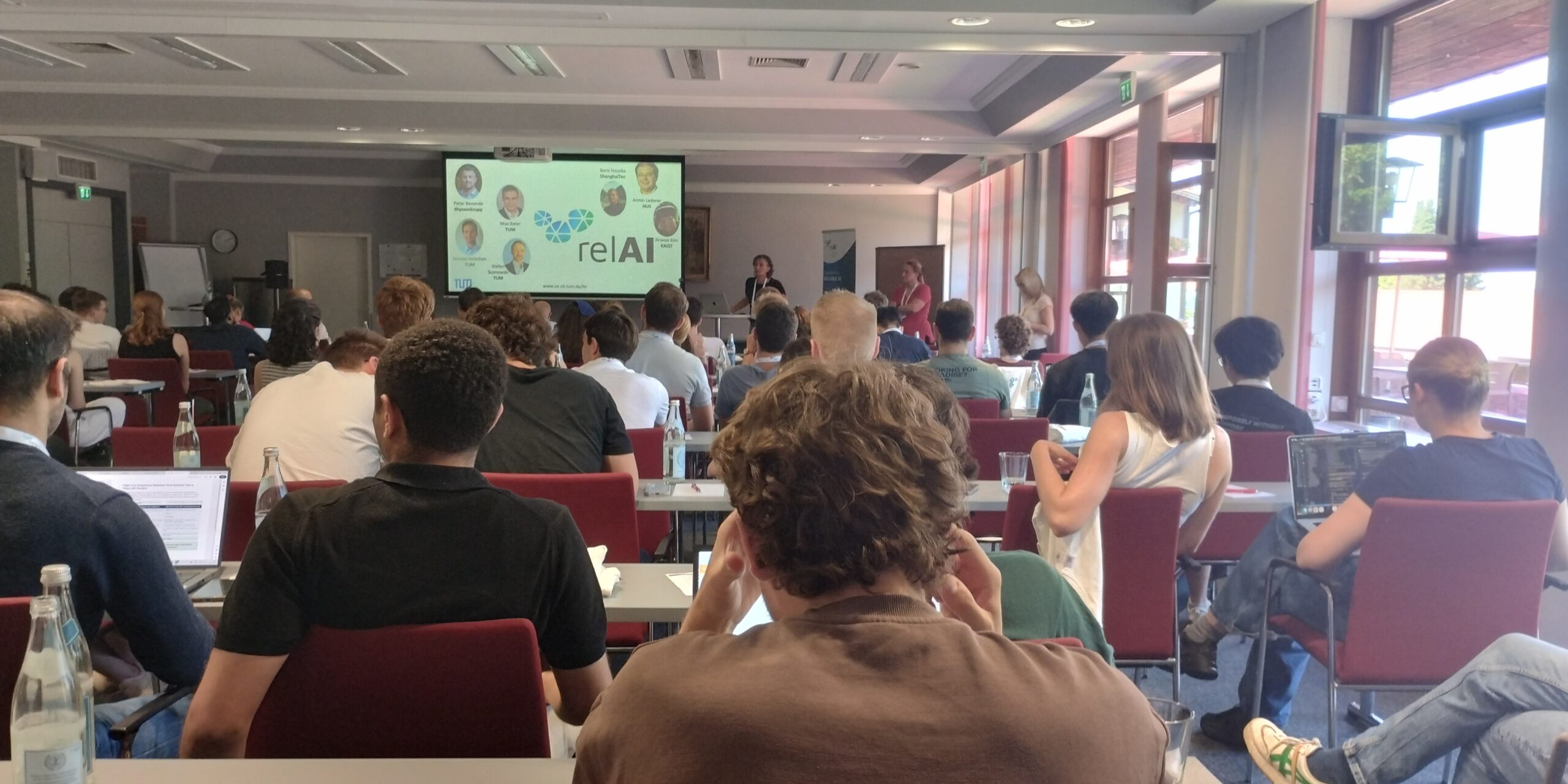
The 🌍 International Symposium on Future Learning 🎓, organized by the TUM Center for Educational Technologies and relAI will address this significant question, which lies at the heart of the Learning & Instruction relAI research area.  

Key Information

📅 8. June 2026 9:15 - 14:00

📍Lecture hall 605, Marsstraße 20, München

🙋‍️ Registration Link

Highlights of the symposium:

To help us plan, please make sure to RSVP via the registration link

We look forward to seeing you on June 8th!

Ethics training in the field of Artificial Intelligence (AI) is essential. AI is revolutionizing our world and transforming various aspects of society, including education, politics, and economics. Researchers in AI are facilitating these changes by developing the conceptual and technical foundation 🧱 for new social structures.

🤔 However, are AI researchers fully aware of their responsibility and the impact of their work on future society?

To encourage reflection on these issues and provide foundational ethics training, relAI recently introduced an Ethics course as a mandatory part of the curriculum. The course is taught by Prof. Ruth Müller from the Department of Science, Technology, and Society at the TUM School of Social Sciences and Technology at Technische Universität München. The first edition took place last winter semester and was well received by relAI students.

One of these students, Valentine Idakwo, has written an insightful blog post to share the lessons learned from the course. This engaging lecture encourages students of AI to analyze their work from an external perspective, considering the social context in which their work is embedded.

👉 Check it out! https://zuseschoolrelai.de/blog/social-impact-ai-research-relai/

📢 We are excited to announce that the call for applications to the MSc program 2026 of our Konrad Zuse School of Excellence in Reliable AI (relAI) is now open!

The innovative relAI MSc program is an addition to the MSc program at TUM or LMU, offering a cross-sectional training for successful education in AI. It provides a coherent, yet flexible and personalized training by enhancing scientific knowledge, professional development courses, and industrial exposure.  

Funded applicants will receive a scholarship of up to 992 EUR (depending on independent income). They are further supported by travel grants, e.g., for home travel.  

We highly encourage you to apply if you have: 

📆 Application Deadline: 15 June 2026 (23:59 AOE)

🔗 Apply now: https://zuseschoolrelai.de/application/#MSc-Program-Application

Please help us in spreading the word, especially to excellent international candidates.

Are you interested in contributing research for underserved communities? Don't miss the EEAMO Conference 2026, the 6th ACM Conference on Equity and Access in Algorithms, Mechanisms, and Optimization.

relAI is excited to support the conference, which will take place from November 5 to 7, 2026. EEAMO 2026 is organized by LMU, with relAI Fellow Christoph Kern and relAI Student Clara Strasser Ceballos serving as General Chairs.

This event will showcase work across the research-to-practice pipeline, aiming to ensure that algorithmic systems serve a broadly beneficial role in society by advancing equity and expanding access to opportunities for underserved communities.

Call for papers: Important Deadlines!

📅 Abstract: May 1
📅 Paper: May 8

relAI research will be featured at the International Conference on Learning Representations (ICLR), which will take place this year at the Riocentro Convention and Event Center in Rio de Janeiro, Brazil, from April 23rd to 27th, 2026. ICLR is one of the leading conferences with significant impact and reputation in machine learning and artificial intelligence research.

relAI Publications at ICLR

Meet relAI Students

If you attend ICLR, be sure to take the opportunity to discuss relAI research with relAI students attending the conference: Sarah Ball, Cecilia Casolo, Lukas Gosch, Valentyn Melnychuk, Ole Petersen, Yusuf Sale, Yan Scholten, Jonas von Berg, and Jingpei Wu. You can find their research papers in the list below.

Full list of relAI publications at ICLR 2026:

    Main Track


  1. Efficient Credal Prediction through Decalibration
    Paul Hofman, Timo Löhr, Maximilian Muschalik, Yusuf Sale, Eyke Hüllermeier
  2. Discrete Bayesian Sample Inference for Graph Generation
    Ole Petersen, Marcel Kollovieh, Marten Lienen, Stephan Günnemann
  3. Identifiability Challenges in Sparse Linear Ordinary Differential Equations
    Cecilia Casolo, Sören Becker, Niki Kilbertus
  4. Sampling-aware Adversarial Attacks Against Large Language Models
    Tim Beyer, Yan Scholten, Leo Schwinn, Stephan Günnemann
  5. Model Collapse Is Not a Bug but a Feature in Machine Unlearning for LLMs
    Yan Scholten, Sophie Xhonneux, Leo Schwinn, Stephan Günnemann
  6. Efficient and Sharp Off-Policy Learning under Unobserved Confounding
    Konstantin Hess, Dennis Frauen, Valentyn Melnychuk, Stefan Feuerriegel
  7. Overlap-Adaptive Regularization for Conditional Average Treatment Effect Estimation
    Valentyn Melnychuk, Dennis Frauen, Jonas Schweisthal, Stefan Feuerriegel
  8. GDR-learners: Orthogonal Learning of Generative Models for Potential Outcomes
    Valentyn Melnychuk, Stefan Feuerriegel
  9. IGC-Net for conditional average potential outcome estimation over time
    Konstantin Hess, Dennis Frauen, Valentyn Melnychuk, Stefan Feuerriegel
  10. On the Impossibility of Separating Intelligence from Judgment: The Computational Intractability of Filtering for AI Alignment
    Sarah Ball, Greg Gluch, Shafi Goldwasser, Frauke Kreuter, Omer Reingold, Guy N. Rothblum
  11. Foundation Models for Causal Inference via Prior-Data Fitted Networks
    Yuchen Ma, Dennis Frauen, Emil Javurek, Stefan Feuerriegel
  12. An Orthogonal Learner for Individualized Outcomes in Markov Decision Processes
    Emil Javurek, Valentyn Melnychuk, Jonas Schweisthal, Konstantin Hess, Dennis Frauen, Stefan Feuerriegel
  13. The Price of Robustness: Stable Classifiers Need Overparameterization
    Jonas von Berg, Adalbert Fono, Massimiliano Datres, Sohir Maskey, Gitta Kutyniok

    Journal Track


  1. Adversarial Robustness of Graph Transformers
    Philipp Foth, Simon Geisler, Lukas Gosch, Leo Schwinn, Stephan Günnemann
    Transactions on Machine Learning Research (TMLR), Journal Track Poster - ICLR 2026, 2025
  2. Online Selective Conformal Prediction: Errors and Solutions
    Yusuf Sale, Aaditya Ramdas
    Transactions on Machine Learning Research (TMLR), Journal Track Poster - ICLR 2026, 2025

    Workshops

  1. Exact Certification of Neural Networks and Partition Aggregation Ensembles against Label Poisoning
    Ajinkya Mohgaonkar, Lukas Gosch, Mahalakshmi Sabanayagam, Debarghya Ghoshdastidar, Stephan Günnemann
    ICLR 2026 Workshop on Principled Design for Trustworthy AI
  2. ProcessThinker: Enhancing Multi-modal Large Language Models Reasoning via Rollout-based Process Reward
    Jingpei Wu, Xiao Han, Weixiang Shen, Boer Zhang, Zifeng Ding, Volker Tresp
    ICLR 2026 Workshop on Logical Reasoning of Large Language Models

We are happy to announce that Barbara Plank has joined relAI as a Fellow!

Barbara is Full Professor for AI and Computational Linguistics at LMU Munich, where she holds the Chair in AI & Computational Linguistics and co-directs the Center for Information and Language Processing (CIS). She also serves as Head of the Munich AI & NLP lab (MaiNLP) and visiting Professorship at the IT University of Copenhagen

Her research on robustness, domain shift, and human label variation aligns well with relAI’s Algorithmic Decision Making research area. This work explores how AI systems learn and make decisions in the face of uncertainty and disagreement. Additionally, her emphasis on interpretability, reasoning, and trustworthy evaluation provides essential foundations for developing reliable, fair, and transparent algorithmic decision systems.

At relAI, Barbara will contribute by participating in seminars, workshops, and panels, as well as offering career advice.

A warm welcome! 🤝

📋Textual generative models, such as the GPT family, have created new opportunities for human–AI interaction. They possess impressive abilities to summarize lengthy documents, compose poetry, and answer complex questions. However, alongside these remarkable capabilities lies a significant challenge: 🪄 hallucinations.

🔹What are hallucinations

Hallucinations are instances in which a model generates content that is factually incorrect, lacks supporting evidence, or is entirely fabricated.

🔹Why is preventing hallucination important

The implications of hallucination can be severe in various real-world domains. In healthcare, hallucinated outputs might suggest non-existent treatments, potentially placing patients at risk. In legal contexts, fabricated precedents could mislead practitioners and affect judicial outcomes. Similarly, in journalism, factual errors in AI-generated articles could lead to misinformation and erode public trust in media institutions. These examples underscore that hallucination is not just a technical flaw; it is a serious societal concern.

In his first post, relAI PhD student Bailan He explains various scenarios that may lead to hallucinations in generative models. He discusses the approaches developed to detect and mitigate these issues.

This post provides a basic summary of strategies designed to ensure that generative models fulfill their essential responsibility: ✨ producing truthful content ✨.

👉 Do not miss it!  https://zuseschoolrelai.de/blog/responsible-textual-generative-models-part-i-generating-truthful-content/

🎉 relAI is proud to announce that the International Association for Dental, Oral, and Craniofacial Research (IADR) has named relAI Fellow Falk Schwendicke as the recipient of the 2026 IADR Distinguished Scientist William H. Bowen Research in Dental Caries Award 🦷 .

IADR is a nonprofit organization dedicated to advancing dental, oral, and craniofacial research for global health and well-being. This esteemed IADR award recognizes exceptional and innovative contributions to our understanding of caries etiology and the prevention of dental caries. It is one of the 17 IADR Distinguished Scientist Awards and is considered one of the highest honors bestowed by the organization.

Falk Schwendicke’s Research Achievements

His early work focused on minimally invasive and evidence-based caries management, particularly regarding selective carious tissue removal and its economic evaluation. This research has laid the groundwork for contemporary treatment guidelines. His recent studies have increasingly emphasized the integration of emerging technologies to overcome challenges in caries detection and management. Notably, he has been a pioneer in employing advanced artificial intelligence (AI) applications for radiographic analysis, diagnostic support, and predictive modeling.

A significant achievement in his career was leading a randomized controlled trial that evaluated AI-assisted caries detection. This study set new standards for clinical research in the field and informed subsequent cost-effectiveness analyses. Schwendicke also participates in numerous editorial and review roles and has presented at the IADR General Session and various scientific meetings. He has authored over 500 peer-reviewed publications and 30 book chapters and is ranked among the top 1% of most-cited dental researchers worldwide, according to the Stanford global ranking.

👉 Information sources

https://www.iadr.org/about/news-reports/press-releases/falk-schwendicke-named-recipient-2026-iadr-distinguished

https://www.linkedin.com/posts/prof-dr-falk-schwendicke-9bb6271a1_iadr2026-activity-7444709023079350272-kiFG/?utm_source=share&utm_medium=member_ios&rcm=ACoAAAMg4egBnT-dMw4VyJR7tdTe0Z-9xhGUZZI

Welcome on board 🛳️ !

relAI Fellow Carsten Marr is Professor for AI in Cell Therapy and Hematology at the Medical Faculty and Clinics of the Ludwig-Maximilians-Universität München, as well as Director of the Institute of AI for Health at Helmholtz Munich.

In recent years, he has made significant contributions to AI-based hematological cytology. His focus on the interpretability of models trained on patient data to make predictions in a biomedical context 🩺 closely aligns with relAI's central themes of safety and responsibility. His innovative multiple instance learning models facilitate the investigation of relevant cells for disease prediction, while sparse autoencoders help correlate image features with diagnostic concepts. Additionally, his work on linking images and language enables direct comparisons between understandable human terms and cellular patterns within gigabyte-sized digital scans. At relAI, he will support students through lectures, mentoring, and participation in events.

🎉 Congratulations!

relAI is thrilled to announce that Frauke Kreuter, relAI Fellow and member of the relAI Steering Committee, has been elected a Fellow of the American Association for the Advancement of Science (AAAS). AAAS is the world's largest general scientific society and publisher of the journal Science. Founded in 1848, this non-profit international organization promotes scientific freedom, responsibility, education, and collaboration to improve humanity, serving over 120,000 members.

Being elected as a Fellow is a prestigious honor that recognizes individuals whose contributions to advancing science and its applications in service to society have distinguished them among their peers and colleagues.

👉 More Information: https://www.lmu.de/ai-hub/en/news-events/all-news/news/prof.-dr.-frauke-kreuter-wins-2026-waksberg-award.html