
How can agentic research work in practice?

Frontier AI systems have recently solved IMO problems, discovered new mathematical constructions, and resolved open Erdős problems. Yet a more mundane question remains: 🤔how should a working mathematician actually use these tools day to day?

In this talk, titled “The Agentic Researcher: Turning AI Coding Agents into Research Assistants” Emil Partow, PhD Student of our relAI Director Prof. Gitta Kutyniok presented a recent paper from Prof. Pokutta (Zuse-Institut Berlin) that offers a concrete answer. The authors propose a five-level taxonomy of AI integration into research, ranging from classical work without AI to fully autonomous research loops. They have implemented this idea within an open-source framework.

Following a detailed presentation by Emil Partow, members of relAI and Prof. Kutyniok's research group gathered to discuss this forward-looking topic. The presentation explained the open-source tool that implements core research "commandments" (such as preventing the falsification of experimental data) via a practical, actionable loop. Participants then discussed how AI agents are already shaping research methodologies, what is required to implement these workflows successfully, and how to ensure human oversight remains at the center of the process. Emil also shared a practical case study demonstrating the tool in action, sparking a broader reflection on the evolving role of AI in modern research.
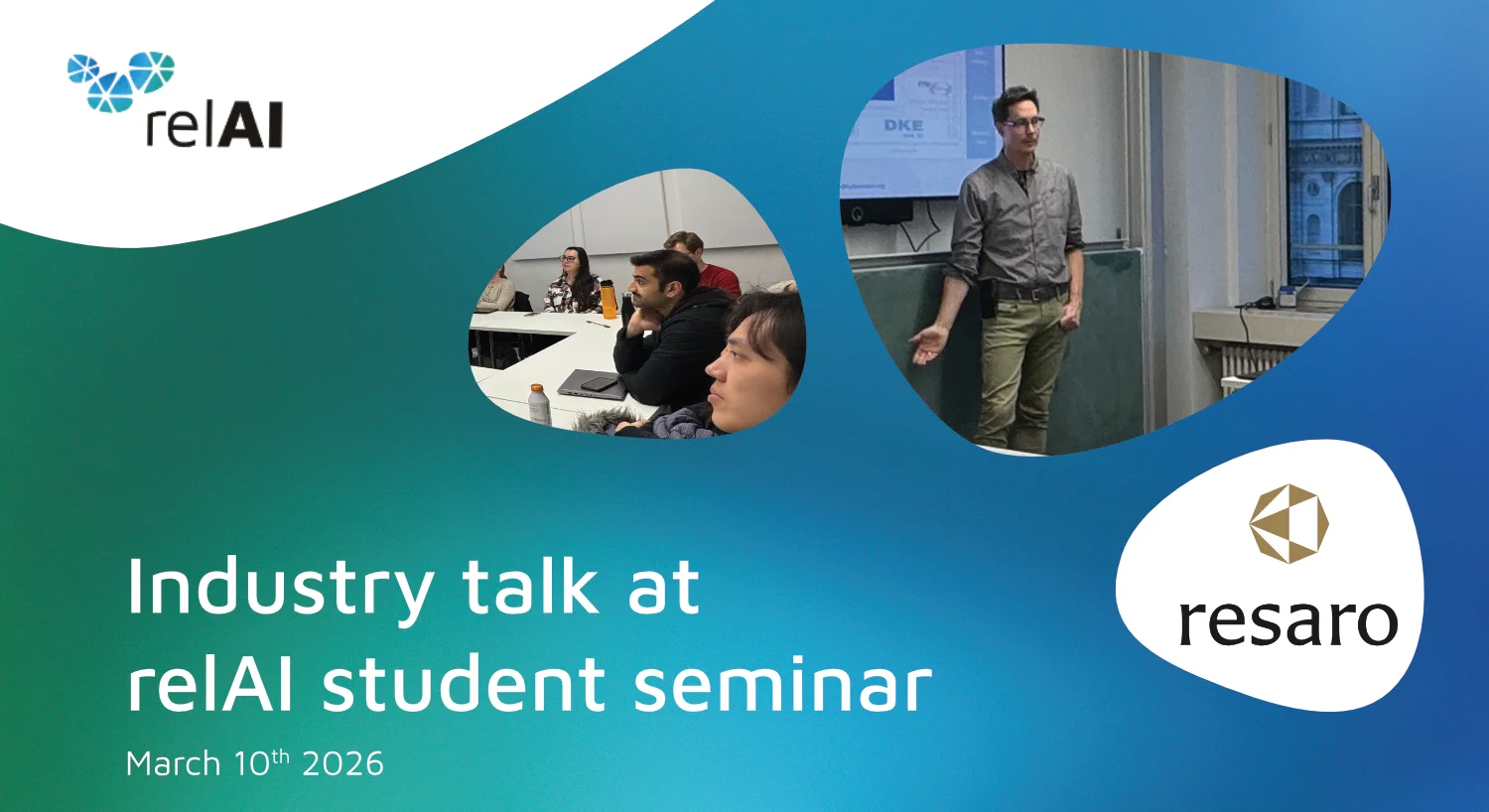
On March 10, relAI students had the privilege of hosting Dr. Sebastian Hallensleben, Chief Trust Officer at the relAI Industry Partner Resaro, as an invited speaker at the relAI student seminar. This seminar serves as an important platform that fosters valuable research exchanges and networking opportunities for our students.

Dr. Hallensleben is an expert at the intersection of AI research, regulation, and industry. He plays a significant role in developing AI standards for Europe as the Chair of CEN-CENELEC JTC 21, where European AI standards are being crafted to support EU regulations. Additionally, he co-chairs the AI risk and accountability initiatives at the Organisation for Economic Co-operation and Development (OECD).

About the Talk

In his talk, he shared valuable insights on the landscape of international AI standards and their development. The first half of the session focused on the EU AI Act, detailing how the currently developing landscape of harmonised standards will provide the technical basis for legal compliance. Moving from regulation to practice, he was joined by Linus Stach to demonstrate how Resaro interacts with this landscape in the development of their AI evaluation platform, navigating the complexity of accurately communicating technical metrics to a wide audience of stakeholders. The speakers then demonstrated their evaluation framework using a case study based on public crime statistics from Baden-Württemberg. They showed how the framework can be used to assess model performance dimensions (such as privacy, consistency and correctness), compare different models, and ensure compliant application. The seminar concluded with an extensive and detailed discussion on the practical challenges of defining and achieving AI reliability in real-world scenarios.

More about the Speaker

Sebastian is the initiator and Programme Chair of the Digital Trust Convention and is Principal Advisor Digital Trust at KI Park. As Chief Trust Officer at Resaro, he works towards drilling down to ground truths about capabilities of AI systems. - Previously, Sebastian Hallensleben headed Digitalisation and Artificial Intelligence at VDE Association for Electrical, Electronic and Information Technologies. He focuses in particular on operationalising AI ethics, on characterizing AI quality and on building privacy-preserving trust infrastructures for a more resilient digital space.