ERC Advanced Grant for relAI Fellow Albrecht Schmidt

We are proud to announce that the European Research Council (ERC) has awarded an Advanced Grant to relAI Fellow Albrecht Schmidt for the project titled “AI Twins of Human Experience: Towards Personal Generative AI Systems for Amplifying Human Cognition.”

ERC Advanced Grants are highly prestigious, providing support to established and leading principal investigators who are pursuing groundbreaking and high-risk projects. This newly funded project aims to establish a scientific foundation for creating AI twins of human experiences. The goal is to store and process these experiences in a way that seamlessly enhances human cognitive and creative abilities. This initiative has the potential to transform the use of personal data, fostering cognitive augmentation and social connectivity through AI.

Find more information about this exciting project via the links below:

https://www.lmu.de/en/newsroom/news-overview/news/two-erc-advanced-grants-for-lmu-researchers-2.html

https://erc.europa.eu/news-events/news/advanced-grants-2024-examples-projects#AItwin

🥂Congratulations!

relAI Fellow Björn Ommer has been awarded the 2024 Eduard Rhein Award Technology Prize. The award ceremony took place on 24 May 2025 at the Flugwerft Schleißheim.

The Eduard Rhein Foundation has honoured Björn Ommer and his team, a group of pioneers in the field of artificial intelligence. Through open and efficient model architectures, the group has democratized access to generative AI. Their approach demonstrates the potential of generative AI not only for images, but also for other modalities such as audio and text, thus laying the foundation for a wide range of applications – from media production, where realistic or creative content is created for presentations, to prototyping in automotive design, to synthetic data to support diagnostics in medical research.

Follow this link to read the complete article.

🥂Congratulations!

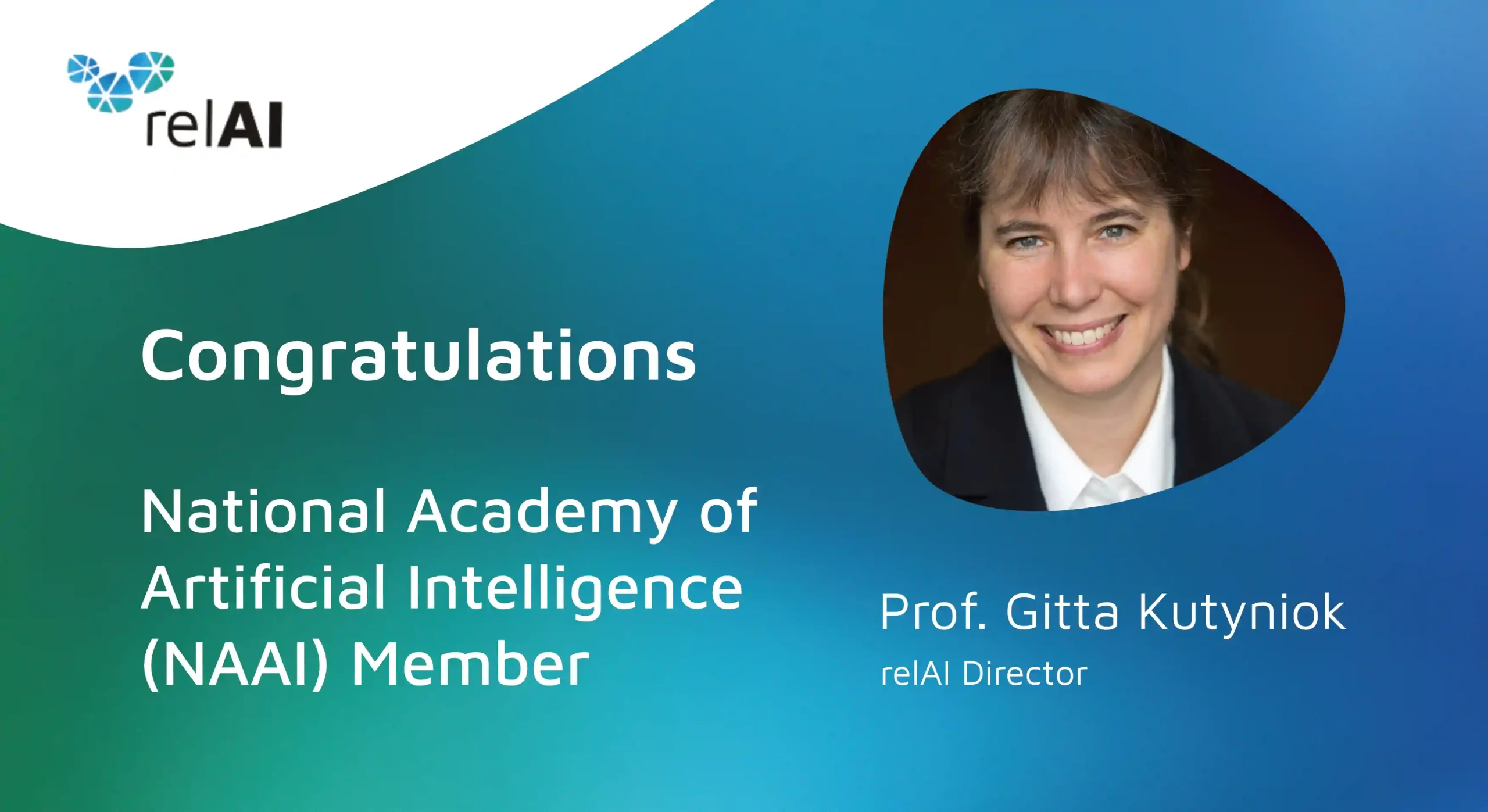
We are proud to announce that our relAI Director Gitta Kutyniok has been invited to become a member of the US National Academy of Artificial Intelligence (NAAI). NAAI is committed to advancing artificial intelligence by fostering collaboration among leading experts and promoting innovative research and development.

The election acknowledges Gitta Kutyniok's distinguished contributions to applied harmonic analysis, compressed sensing, and artificial intelligence. This honor recognizes her leadership as the Bavarian AI Chair for Mathematical Foundations of Artificial Intelligence at Ludwig-Maximilians-Universität München (LMU Munich), which has significantly advanced research and collaboration in these fields. Additionally, NAAI greatly appreciated her recognition as a SIAM Fellow in 2019 and an IEEE Fellow in 2024, which highlights her outstanding accomplishments and the high regard in which she is held by her peers. 

We are proud to announce that relAI Fellow Prof. Solveig Vieluf won the 2024 Young Investigator Award of the American Epilepsy Society (AES). Her abstract, titled “Seizure Monitoring with Combined Diary and Wearable Data - a Multicenter, Longitudinal, Observational Study”, was selected from over 1,500 submissions for this honor.  This award recognizes 20 young investigators conducting basic, translational, or clinical epilepsy research.

She presented her work at the AES Annual Meeting in early December 2024.

Congratulations!

Congratulations!

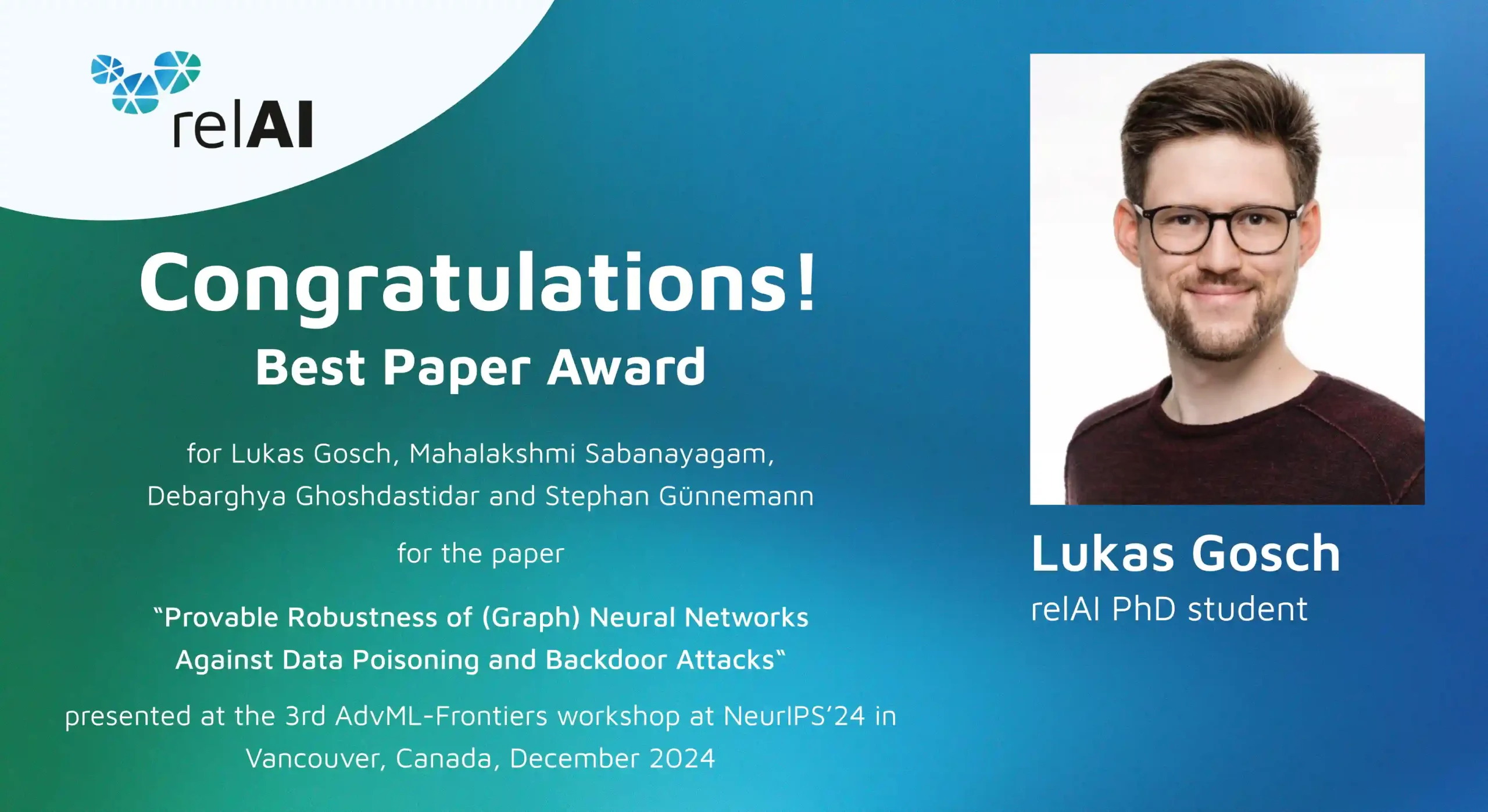
The recent work of relAI PhD student Lukas Gosch has won the Best Paper Award at the 3rd AdvML-Frontiers workshop at the 38th Annual Conference on Neural Information Processing Systems (NeurIPS 2024). The workshop and paper presentation took place at the Vancouver Convention Center in Canada on December 14th, 2024.

Lukas is a PhD student at relAI, advised by the relAI Co-Director Prof. Dr. Stephan Günnemann. His research focuses on robust and reliable machine learning, as well as machine learning on graphs.

The award-winning paper „Provable Robustness of (Graph) Neural Networks Against Data Poisoning and Backdoor Attacks“, that Lukas authored together with Mahalakshmi Sabanayagam and relAI Fellows Debarghya Ghoshdastidar and Stephan Günnemann, develops the first architecture-aware certification technique for common neural networks against poisoning and backdoor attacks.

Explore this outstanding paper here.

Our sincerest congratulations to Lukas and his co-authors on this achievement!

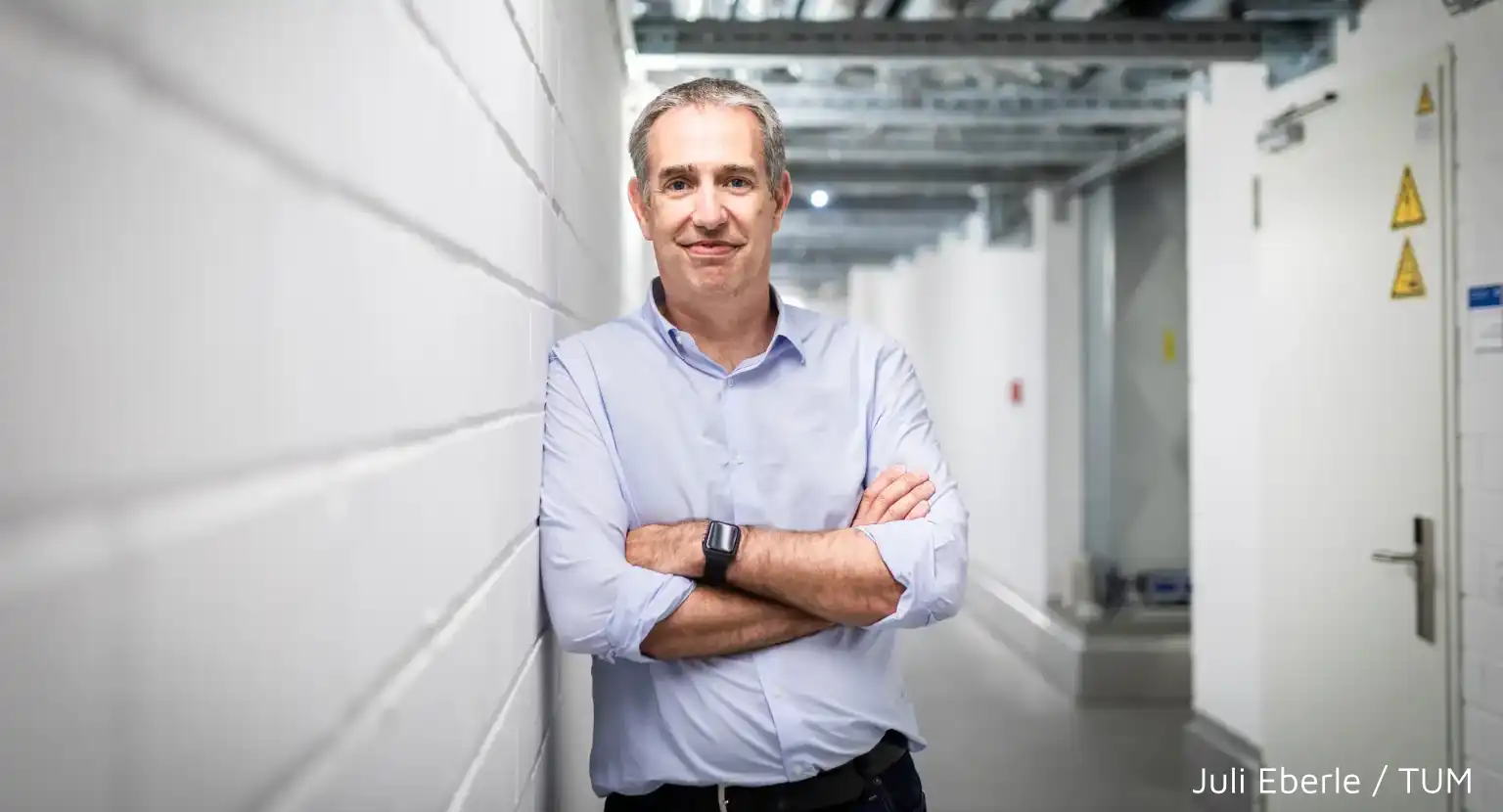
relAI is proud to announce that relAI fellow Prof. Daniel Rückert has been awarded the Gottfried Wilhelm Leibniz Prize 2025. This prestigious award, regarded as the most important German research prize, is endowed with 2.5 million euros by the German Research Foundation (DFG).

The professor of Artificial Intelligence (AI) in Medicine and Healthcare at the Technical University of Munich (TUM) has been honored for his research on AI-assisted medical imaging. He has developed pioneering methods with which AI algorithms can generate particularly informative images from computer tomography or magnetic resonance imaging, analyze them, and interpret them for improved medical diagnostics.

At relAI, he focuses on the safe and privacy aspects of the Medicine & Healthcare research area. His research encompasses several key topics, including reliable machine learning for medical imaging and sensing, privacy-preserving AI, trustworthy medical foundation models, and safe and responsible clinical AI. As a member of the relAI Steering Committee, he represents the Medicine & Healthcare area, playing a crucial role in shaping the organization's goals and future directions of the school.  

Congratulations!

Read more about it: link

Congratulations to relAI Fellow Prof. Dr. Enkelejda Kasneci on receiving the prestigious 2024 Heinz Maier-Leibnitz Medal from TUM. This annual award was presented to Prof. Kasneci at the recent Dies Academicus on December 5th. 

Enkelejda Kasneci is a Distinguished Professor (“Liesel Beckmann Distinguished Professorship”) for Human-Centered Technologies for Learning at the TUM School of Social Sciences & Technology. Her research focuses on Human-Computer Interaction and developing AI systems that sense and infer the user’s cognitive state, expertise, actions, and intentions based on multimodal data. 

Prof. Dr. Enkelejda Kasneci together with her colleague Prof. Dr Tina Seidel, both directors of the TUM EdTech Center, received the Heinz Maier-Leibnitz Medal 2024 in recognition of their “outstanding research in the field of digital teaching and learning as well as their commitment to establishing the TUM Center for Educational Technologies.” 

Congratulations on this achievement! 

Congratulations!

Our relAI Fellow Björn Ommer was nominated for the Deutscher Zukunftspreis for his work on "Democratisation of Generative AI - Stable Diffusion from Development to Practice".

With the Deutscher Zukunftspreis, the German Federal President acknowledges outstanding achievements in technology, engineering, and science, as well as software and algorithm-based innovations that significantly expand the international state of research and technology and are already being used in practice. The prestigious award is endowed with 250,000 euros.

Björn Ommer and his team have developed a groundbreaking Stable Diffusion Model for image generation, which serves as a foundational technology for many AI models, including those from Google and OpenAI.

We’re proud to have Prof. Ommer in our relAI family.

Congratulations! relAI student Sameer Ambekar wins the best paper award at the MICCAI Workshop on Advancing Data Solutions in Medical Imaging AI (ADSMI). 

Sameer is a PhD student at relAI, advised by the relAI Fellow Julia A. Schnabel. His research focusses on test-time adaptation and domain generalization for medical imaging. 

His award-winning paper “Selective Test-Time Adaptation for Unsupervised Anomaly Detection using Neural Implicit Representations”, co-authored with Julia A. Schnabel and Cosmin Bereca, presents a novel zero-shot methodology to adapt models in real time to test images from new domains using deep pre-trained features. The approach is validated on brain anomaly detection data. 

This work addresses domain shift at test-time, which Sameer explains in more detail in his recently published relAI blog post. In the post, you can also learn about the importance of handling domain shifts to make AI more reliable: https://zuseschoolrelai.de/blog/mitigating-domain-shifts/  

Congratulations on this achievement!  

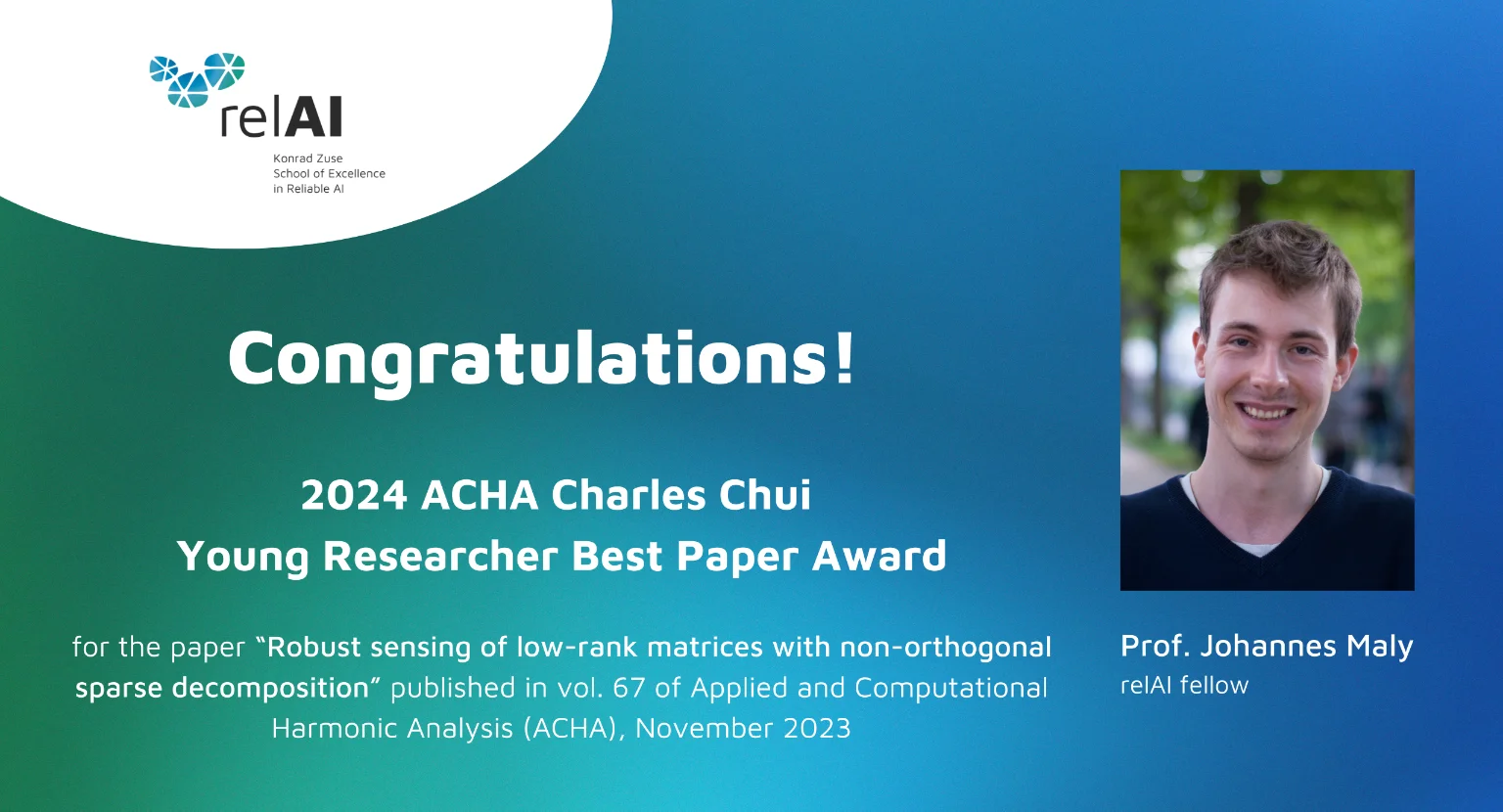
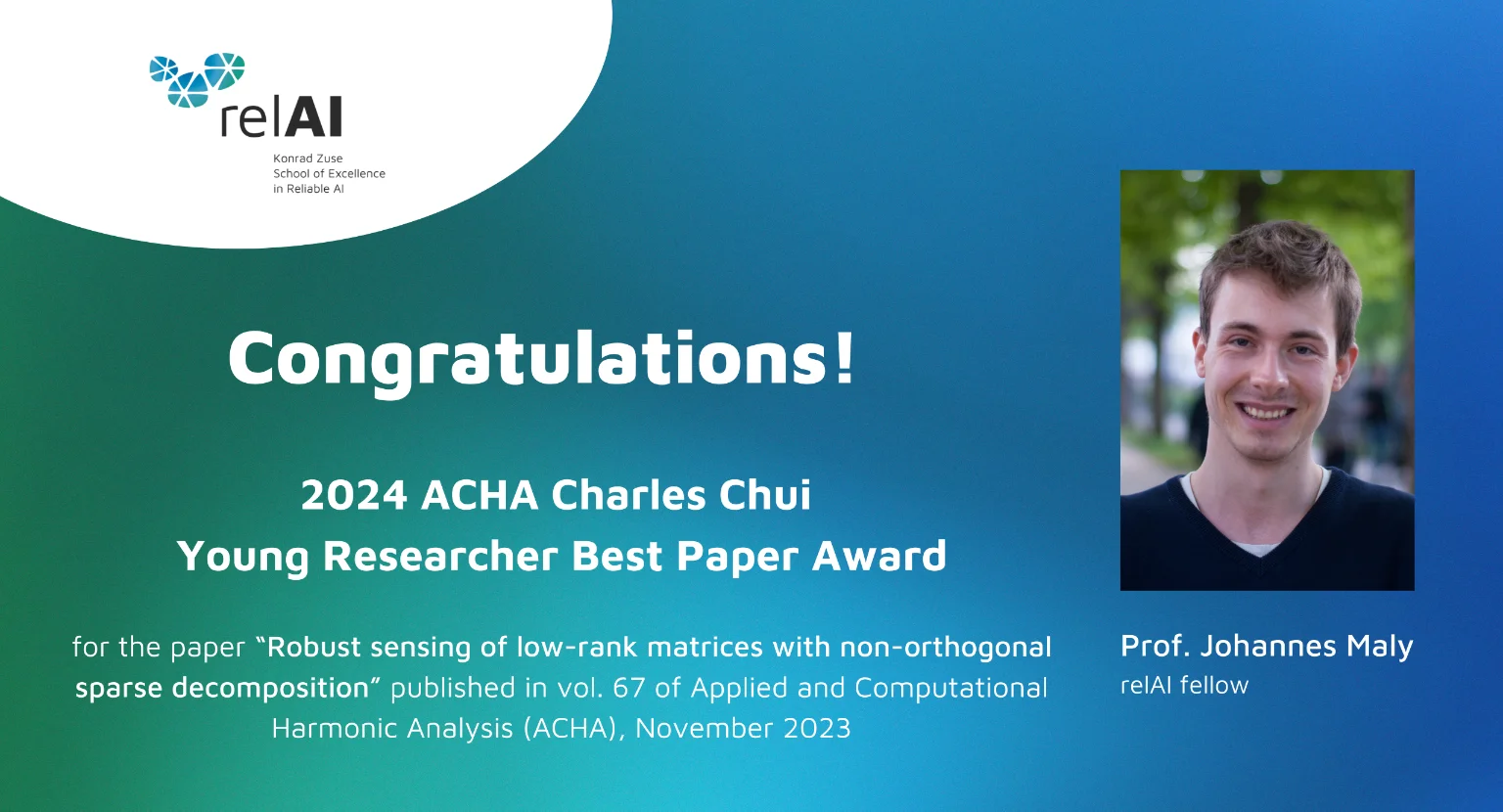
Congratulations to relAI fellow Johannes Maly on winning the 2024 ACHA Charles Chui Young Researcher Best Paper Award!

This annual award honors the exceptional contributions of young researchers in the field of harmonic analysis, selected by the editors and publisher of the Journal Applied and Computational Harmonic Analysis (ACHA)

Johannes received this recognition for his paper, “Robust Sensing of Low-Rank Matrices with Non-Orthogonal Sparse Decomposition,” published in November 2023 (Vol. 67, ACHA). His research focuses on understanding how to leverage intrinsic models or data structures and how the loss of information caused by digital processing (quantization) affects theoretical results. This is highly relevant for resource-aware and reliable AI