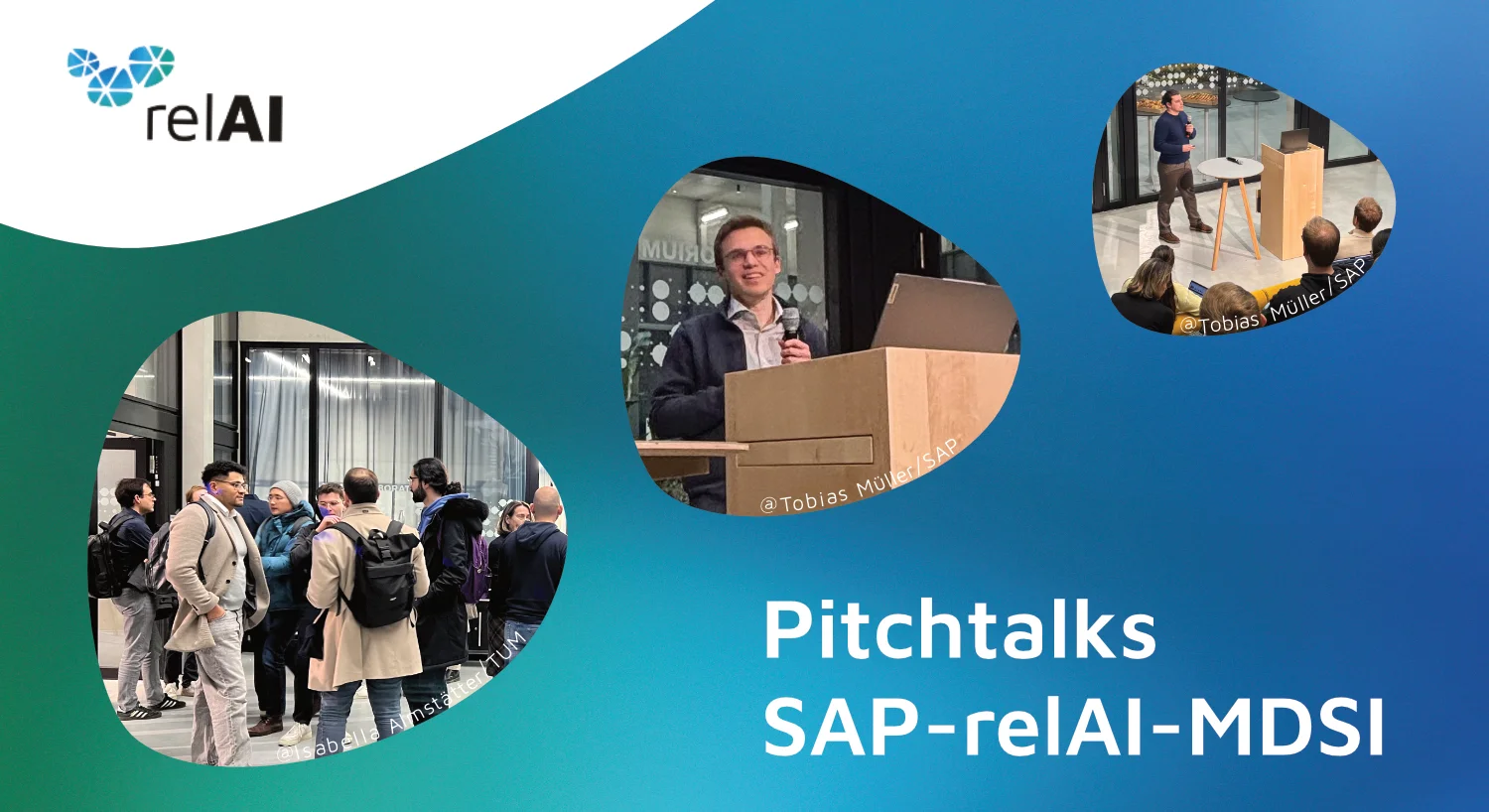
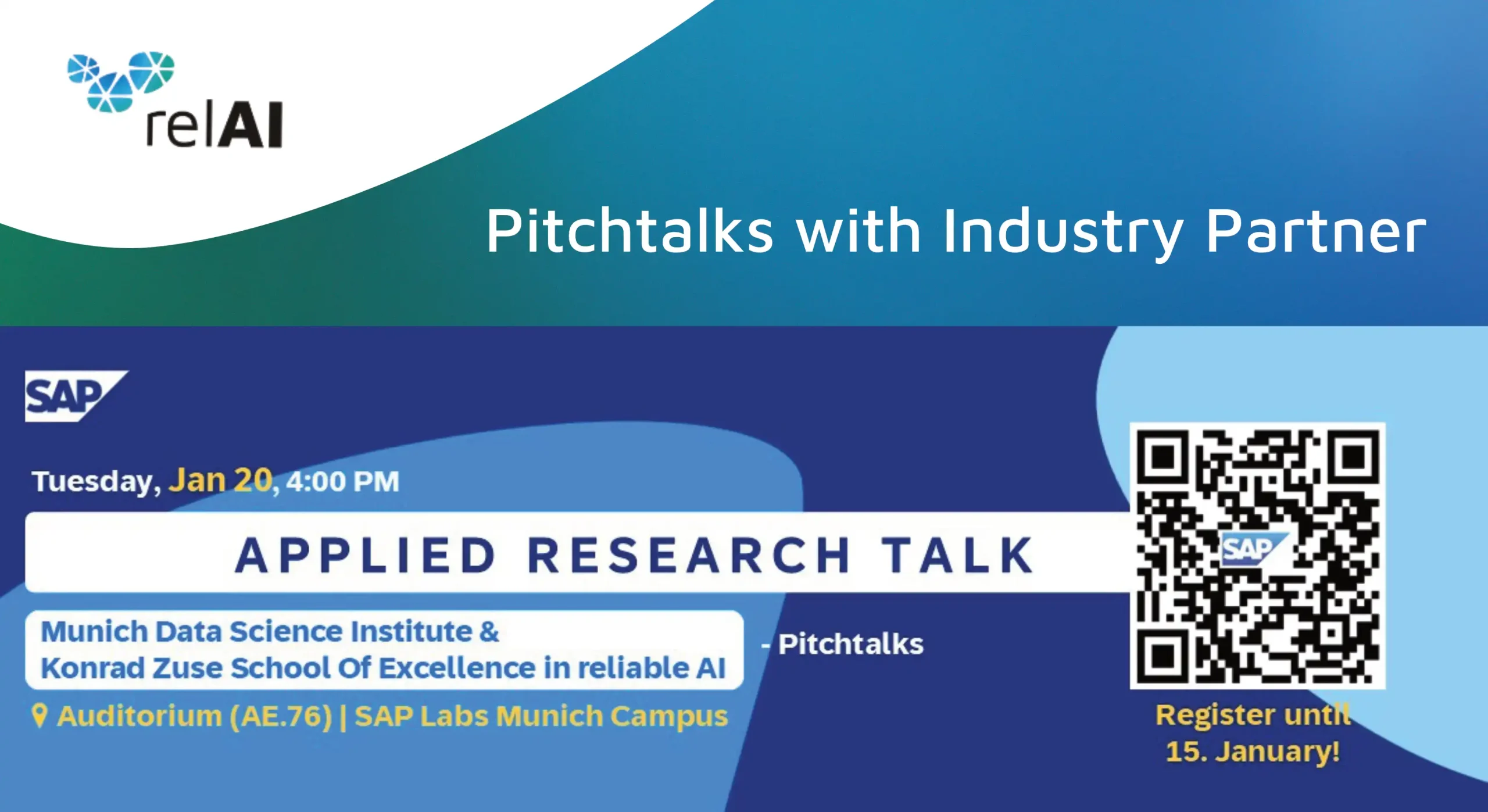
Join us for a lively meetup featuring leading researchers from MDSI, relAI, and experts from relAI Industry Partner SAP, where we will connect, discuss, and explore new ideas.
🗓️ January 20, 2026, 4:00 - 5:30 pm (doors open at 3:30 pm, open networking after the talks)
📍 SAP Labs Munich Campus (MUE03), Friedrich-Ludwig-Bauer-Straße 5, 85748 Garching bei München, Auditorium (AE.76)
👉Registration: here
ℹ️ More information: Questions? Please contact iuc-tum(at)sap.com.
Confirmed speakers:
Max Beier (relAI): Learning, Optimization, and Uncertainty in Dynamical Systems with Linear Operators
Dynamical systems are ubiquitous in data science and robotics, motivating a broad range of methods for learning models from data, optimizing their behavior, and quantifying uncertainty in their predictions. This talk will showcase how linear-operator methods provide a unified way to study learning, optimization, and uncertainty in dynamical systems. Operator learning treats both inputs and outputs as functions and learns mappings between function spaces, which reframes dynamical modeling as the identification of operators from data. Restricting attention to linear operators enables compact representations, output-independent representations, and efficient computation through the use of linear algebra. We will showcase how this framework can be successfully employed to: learn a representation of a dynamical system for optimal control, model distributions over trajectories efficiently, and generate coherent sequences.
Sebastian Gallenmüller (MDSI): SLICES-DE: Digital Research Infrastructure for Computing and Communication
SLICES-DE (Scientific Large-scale Infrastructure for Computing/Communication Experimental Studies - Germany) is a digital research infrastructure and Germany’s national node of the European SLICES-RI initiative. It provides a remote-accessible experimental platform for researchers in information and communication technologies (ICT) with structured workflows to support reproducible experiments and long-term data archiving. The infrastructure is designed to be flexible and scalable to a wide range of research domains, including 6G networks, AI, cybersecurity, and cloud-to-edge systems. SLICES-DE aims to provide a research infrastructure for ICT research in Germany, with engagements possible for academic and industry partners.
Parastoo Pashmchi (SAP): Handle your Missing Values Easily: An ML-powered Solution for Filling Data Gaps
Every machine learning and artificial intelligence model relies heavily on data, and managing this data, especially when it comes to dealing with missing values, presents a significant challenge for data scientists. Missing data can lead to a loss of vital information needed for training models and can disrupt the patterns or relationships that prediction algorithms rely on. For example, incomplete financial datasets can yield flawed risk assessments, while missing information in clinical trials or engineering sensor data can compromise the validity of study outcomes and fault detection, respectively. Similarly, missing weather data can lead to inaccurate green energy generation predictions, affecting grid management and planning. Our proposed method provides a fast and easy-to-implement algorithm for imputing missing values, emphasising the preservation of the original data distribution and pattern based on the available data. This algorithm overcomes some of the limitations of conventional techniques and provides a theoretical guarantee for effectively recovering the distribution of the missing values. Key features of this algorithm include the quantification of uncertainty for each imputed value and the capability for multiple imputations to consider various potential scenarios. These features enhance the reliability and stability of our machine learning model, offering more reliable predictions. In this session, we will highlight the algorithm's main features and demonstrate its application in predictive models.
Mario Picciani (MDSI): ProteomicsDB: A Multi-Omics and Multi-Organism Resource for Life Science Research
ProteomicsDB is an evolving, publicly accessible multi-omics database originally developed to enable the interactive exploration of large quantitative mass spectrometry–based proteomics datasets, which led to developing the first draft of the human proteome. Initially, the HANA-powered platform supported the real-time comparison of protein abundance across human tissues, cell lines, and body fluids, but was subsequently expanded to integrate other omics layers such as transcriptomics, drug-target interactions, protein–protein interactions, and cell viability data, transforming it into a versatile resource for multi-omics life science research. Over further successive updates, ProteomicsDB was expanded to support additional organisms covering nearly all branches of the tree of life facilitating research towards the concept of “One Health” - integrating and broadening our understanding of the interactions between humans, animals, plants, microorganisms, soil, and the environment to ensure a sustainable and resilient future of healthy living. The latest update strengthened its role to facilitate the comprehensive analyses of drug mechanisms, cell sensitivity profiles, and biomolecular signatures to support precision medicine applications. ProteomicsDB’s rich data content makes it an ideal resource for basic to translational research, with applications in systems biology, and drug discovery, and its versatile and extendible architecture makes it an ideal platform for large-scale research initiatives, illustrated by its central role in projects such as ‘The Proteomes That Feed The World’ and ‘Reducing Non-Human Primates in Non-Clinical Safety Assessment’.