
Research Areas
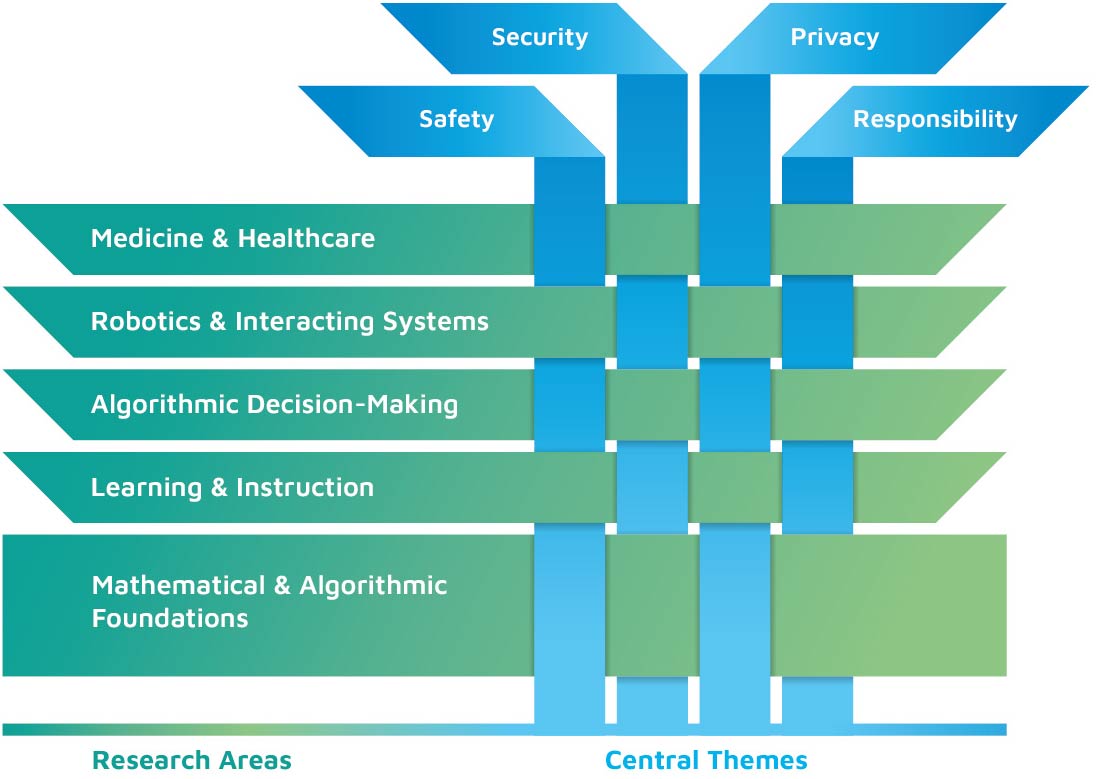
The research program combines mathematical and algorithmic foundations of reliable AI along with domain knowledge in four core application domains: medicine & healthcare, robotics & interacting systems, algorithmic decision-making and learning & instruction.
Reliability of AI with all its facets can only be achieved through a profound understanding of its foundations. In fact, the current gap between theory and practice of AI methodologies is one of the key obstacles for deriving comprehensive guarantees as required by critical applications. Supporting our goal of reliable AI, the general research challenges we aim to address are twofold.
Firstly, we aim to establish theoretical guarantees for AI. This includes expressivity of AI models, analysis of learning algorithms, generalization capabilities of trained AI systems, and aspects such as robustness, aiming predominantly at concrete error bounds and certification. A particular challenge are novel and highly complex architectures such as graph neural networks or transformers.
Secondly, to support reliability, we research algorithmic foundations of AI on relevant topics, such as IT security, federated learning, distributed systems, and causal modeling, thereby ensuring a tight link to the application domains and their practical realization.

Zeynep Akata
Interpretable and Reliable Machine Learning (TUM)

Stefan Bauer
Data Science and Intelligent Systems (TUM, Helmholtz AI)

Pramod Bhatotia
Decentralized Systems Engineering (TUM)

Bernd Bischl
Statistical Learning & Data Science (LMU)

Daniel Cremers
Computer Vision and Artificial Intelligence (TUM)

Mathias Drton
Mathematical Statistics (TUM)

Vincent Fortuin
Efficient Learning and Probabilistic Inference for Science (Helmholtz AI)

Debarghya Ghoshdastidar
Theoretical Foundations of AI (TUM)

Stephan Günnemann
Data Analytics & Machine Learning (TUM)

Reinhard Heckel
Machine Learning (TUM)
Eyke Hüllermeier
Artificial Intelligence & Machine Learning (LMU)
Gjergji Kasneci
Responsible Data Science (TUM)

Christoph Kern
Social Data Science and Statistical Learning (LMU)

Niki Kilbertus
Ethics in Systems Design & Machine Learning (TUM, Helmholtz)

Gitta Kutyniok
Mathematical Foundations of AI (LMU)
Johannes Maly
Mathematical Data Science (LMU)

Björn Ommer
Computer Vision & Learning (LMU)

David Rügamer
Department of Statistics (LMU)

Tom Sterkenburg
Philosophy of Science (LMU)

AI has the potential to fundamentally transform the future of medicine and healthcare by enabling earlier and more accurate diagnosis and better treatment, leading to improved outcomes for patients and increased efficiency in healthcare. The emergence of AI for medicine and healthcare also offers a number of transformative opportunities for economic growth. Examples cover prevention and early detection, e.g. AI for wearable devices as well as AI for screening (e.g. mammography). In relAI, we combine the expertise in AI healthcare and medicine to successfully tackle these challenges.
A key requirement for the successful deployment of AI in clinical environments is the development of safe, secure, and trustworthy ML techniques. In particular, advances are required in robust and data efficient learning, privacy preservation, and interpretable deep learning.
Stefan Bauer
Data Science and Intelligent Systems (TUM, Helmholtz AI)

Alena Buyx
Ethics in Medicine and Health Technologies (TUM)
Daniel Cremers
Computer Vision and Artificial Intelligence (TUM)
Björn Eskofier
AI-Supported Therapy Decisions (LMU)

Michael Ingrisch
Clinical Data Science (LMU)
Niki Kilbertus
Ethics in Systems Design & Machine Learning (TUM, Helmholtz)

Alexander König
Robotics and Systems Intelligence (TUM, MIRMI)
Tobias Lasser
Computational Imaging and Inverse Problems (TUM)

Carsten Marr
AI for Health (LMU, Helmholtz)
Nassir Navab
Computer Aided Medical Procedures & Augmented Reality (TUM)

Daniel Rückert
AI in Healthcare & Medicine (TUM)

Julia Schnabel
Computational Imaging & AI in Medicine (TUM, Helmholtz)

Björn W. Schuller
Health Informatics (TUM)
Falk Schwendicke
Conservative Dentistry, Periodontology and Digital Dentistry (LMU)
Fabian Theis
Mathematical Modelling of Biological Systems (TUM)

Solveig Vieluf
AI-based telemonitoring (LMU)

Christian Wachinger
Artificial Intelligence in Medical Imaging (TUM)

Benedikt Wiestler
AI for Image-Guided Diagnosis and Therapy (TUM)
Engineers and computer scientists are currently developing autonomous systems with AI techniques as a core component. This provides endless possibilities but also comes with enormous challenges regarding safety, security, and privacy. For example, how to guarantee safety of an autonomous agent (e.g., a robot in a human environment) under all circumstances, given that a designer cannot foresee all situations the agent will face in the future? How to balance the advantages of AI cloud computing with the increased risk of security violations? How to leverage data to adapt to the needs of a human user while bearing privacy concerns in mind? To answer such questions, relAI will focus on safe, secure, and privacy-preserving AI in the context of autonomous agents and interacting systems.


Alin Albu-Schäffer
Sensor Based Robotic Systems & Intelligent Assistance Systems (TUM) German Aerospace Center (DLR) I. Robotics & Mechatronics

Matthias Althoff
Cyber Physical Systems (TUM)
Hussam Amrouch
AI Processor Design (TUM)
Pramod Bhatotia
Decentralized Systems Engineering (TUM)

Andreas Butz
Human-Computer-Interaction (LMU)
Daniel Cremers
Computer Vision and Artificial Intelligence (TUM)
Björn Eskofier
AI-Supported Therapy Decisions (LMU)

Sandra Hirche
Information-oriented Control (TUM)

Valentin Hofmann
Natural Language Processing (LMU)

Enkelejda Kasneci
Human-Centered Technologies for Learning (TUM)
Majid Khadiv
AI Planning in Dynamic Environments (TUM)
Alexander König
Robotics and Systems Intelligence (TUM, MIRMI)

Lorenzo Masia
Intelligent Bio-Robotic Systems (TUM, MIRMI)

Albrecht Schmidt
Human-Centered Ubiquitous Media (LMU)

Angela Schoellig
Performance and Reliability for Learning Systems (TUM)

Hinrich Schütze
Computational Linguistics (LMU)

Ever more applications in AI consider prescriptive modeling in the sense of learning a model that stipulates appropriate decisions or actions to be taken in real-world scenarios: Which medical therapy should be applied? Should this person be hired for the job? Decisions of that kind are increasingly automated and made by algorithms instead of humans, often relying on AI methods. Our ambition is to develop AI-based methodologies for reliable algorithmic decision-making (ADM).
This comes with the need to address specific technical issues such as the lack of an objective “ground truth” underlying every prediction, and learning from partial training information, comprising feedback about the decision made, while lacking information about counterfactuals. Methodological research on ADM will be complemented by more application-oriented research on reliable decisions in business and management.
Zeynep Akata
Interpretable and Reliable Machine Learning (TUM)
Hussam Amrouch
AI Processor Design (TUM)
Stefan Bauer
Data Science and Intelligent Systems (TUM, Helmholtz AI)

Stefan Feuerriegel
AI in Management (LMU)
Eyke Hüllermeier
Artificial Intelligence & Machine Learning (LMU)
Gjergji Kasneci
Responsible Data Science (TUM)

Göran Kauermann
Statistics in Economics, Business Administration and Social Sciences (LMU)
Majid Khadiv
AI Planning in Dynamic Environments (TUM)

Frauke Kreuter
Statistics & Data Science in Social Sciences & the Humanities (LMU)

Barbara Plank
AI & Computational Linguistics (LMU)
David Rügamer
Department of Statistics (LMU)
Falk Schwendicke
Conservative Dentistry, Periodontology and Digital Dentistry (LMU)

Volker Tresp
Database Systems & Data Mining (LMU, Siemens)
This research area explores how reliable AI can transform learning and teaching through intelligent tutoring systems, digital learning assistants, and adaptive feedback mechanisms. It addresses the robustness and pedagogical effectiveness of such systems, particularly in the face of incomplete or biased data. Central challenges include ensuring privacy, fairness, and responsibility in data-intensive educational contexts, as well as understanding the broader effects of AI on learners and teachers. A special focus lies on explainability and trust, investigating how transparent and pedagogically meaningful communication of AI-driven actions can foster agency and metacognitive skills. By combining expertise from AI methodology, learning sciences, and education research, this area creates strong synergies with relAI’s other domains, ranging from fair assessment and robust learner modeling to socially interactive learning environments and simulation-based training in medicine.
Enkelejda Kasneci
Human-Centered Technologies for Learning (TUM)
Jochen Kuhn
Physics Education Research (LMU)